

Herring
Reflections on fish, truth, and consequences

Mr. Brent told us that in the mid 1950’s, he would catch bushels of river herring (with a dip net) from the portion of Potomac Creek between the Route 627 bridge (stream mile 12.5) and the site of the Abel Lake Dam (stream mile 13.2)... M.J. Morgan told us that most river herring runs during a given spawning season no longer extend upstream beyond [the railroad bridge]; however, on one or two days out of the spawning season, some river herring continue upstream at least as far as the Route 626 bridge, but not in sufficient numbers to attract fishermen.
From a 1988 report by Virginia Tech’s Department of Fisheries and Wildlife Sciences (p. 90).
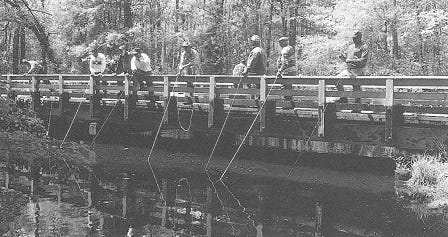
It’s now mid-May.
The annual migration of river herring is just about done.1 The skinny, silvery-white fish have spawned — with any luck, that is, considering the gauntlet of birds and other anglers that lay in wait for them — and are now returning to the Atlantic Ocean.
Old-time residents often fish and swim Stafford County waterways in blue jeans. On Potomac Creek, this behavior can make them stick out in a world of pricey, moisture-wicking fabrics. Shirts are optional gear, too.
Like the old-timers attested in the report above, migratory fish numbers have declined precipitously in just a single human lifetime. Historically, they appeared in the hundreds of millions. For eons, their springtime arrival has been a godsend for parents struggling to feed ravenous offspring. On Potomac Creek, however, human activities of the last two or three generations — pollution, dams, road crossings, and overfishing — have ruined the river herring population.
I enjoy writing about fishing. It’s such an ancient and curious activity. As I’ve written before, fishing opens a portal to what swims below. I would also add that it offers considerable insight into our own psychology and behavior.
Once, fishing off a sunny river dock, I spoke with two pole-carrying young men who were moving deliberately along the river bank, searching for catfish. The bank was muddy and very slick. To my mind it was unpassable, completely overgrown with late summer vines and the types of tangled bushes and unpromising saplings arborists call “trash trees.”
Yet the men’s pursuit was loud and perfectly joyous. One wore a t-shirt and jeans, the other jeans with no shirt. Both had dark lines of wet mud up to their chests. They showed no fatigue, no concern for the heat, humidity, biting insects, abundant poison ivy; they passed the dock speaking only of “getting on” good fish. It was a remarkable moment in my own angling experience: here, embodied, was the mania behind so many thumb-worn collections of short stories and fishing memes.
This mania is tangible. Surely, all peoples who have lived on Potomac Creek have witnessed its power.
More broadly, woods and creeks speak directly to young people drawn to questioning what lies beneath the surface of things, be it water or topsoil. Children respond to wildness before they’re conditioned to fear it. As Aldo Leopold wrote, “Of what avail are forty freedoms without a blank spot on a map?”2
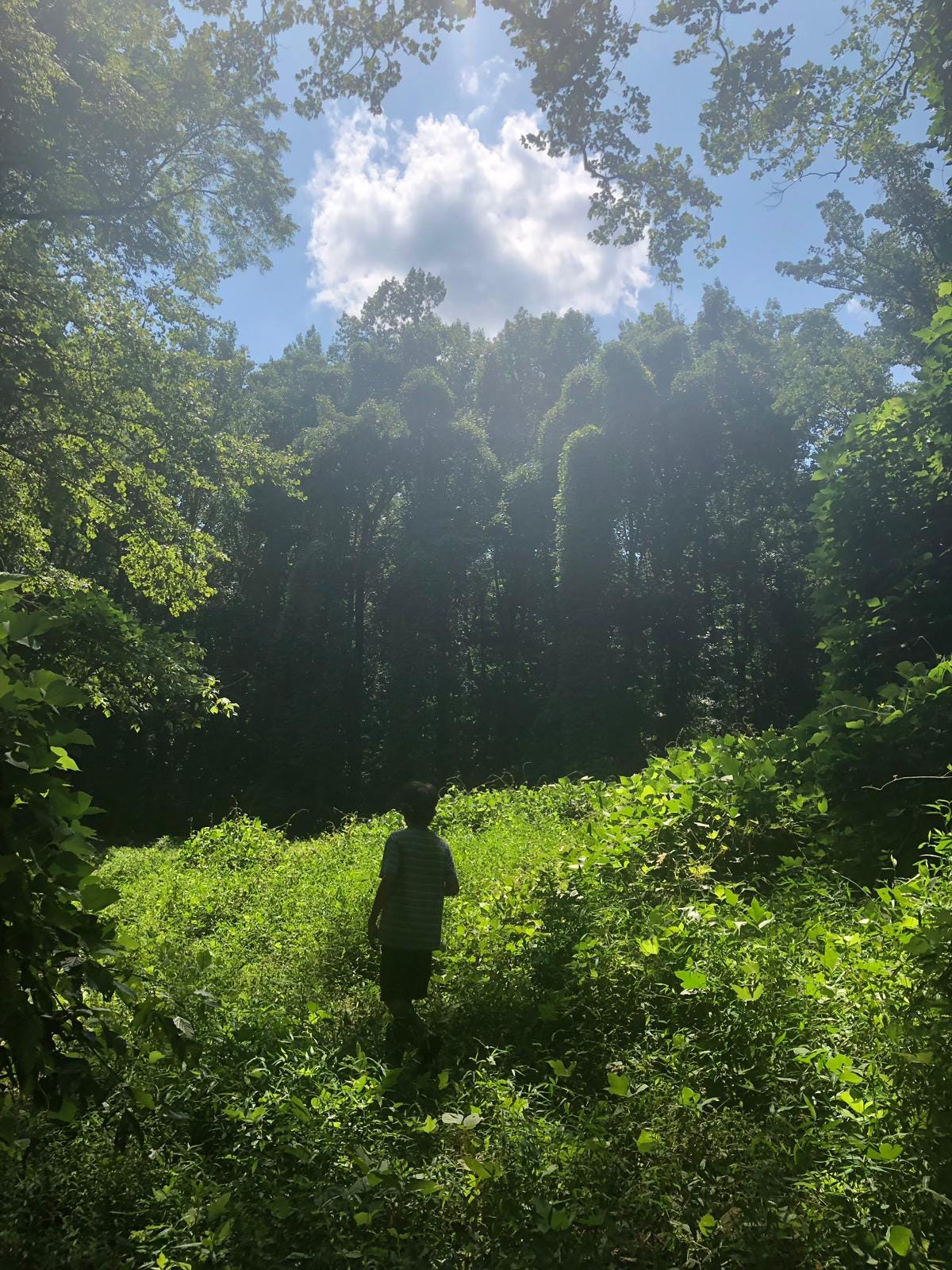
We’ve raised two boys here on Potomac Creek. Decades ago, I was one, too.
One springtime, my friend and I netted spawning herring by the bucket. We pulled them up from the creek’s channels with neither limit nor license. Boastfully, we showed our bounty to Mr. Young, the cornfield farmer, who offered five cents per fish in future catches.
We returned to the creek the next day. Chicken wire nets in hand, we filled plastic trash cans with silver fish. Hours later Mr. Young looked over the hundreds of herring, to which he said “I’ll pay two cents each.”
We were angry and refused to sell. My mother made us clean them all. But our two species’ paths had crossed that day — two young humans and fated schools of migrating herring — and my friend and I had stood over the creek like twin colossi. There had to be consequences.
Boys like us are one reason herring are now all but gone from the creek and illegal to possess.
“Who hears fishes when they cry?” asked Thoreau.3
And who knows which days in the woods will be written about forty years later?
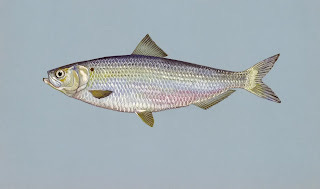
“River herring” is a collective term. Formally, it excludes shad. But blueback herring, alewife, hickory, and American shad look much alike and are members of the same herring family Clupeidae, so many anglers don’t bother to tell them apart.
Aldo Leopold. “Green Lagoons” in A Sand County Almanac. Oxford University Press (1947): 149.