

Erasure
On the destruction of familiar trees

Two events inspire today’s essay. The first is the recent erasure of a small patch of nearby green that had withstood developmental pressures for decades. The second occurred just yesterday, when I unsuccessfully tried to follow a noisy yellow-billed cuckoo through the woods. That chase called to mind an earlier meeting with another little bird.
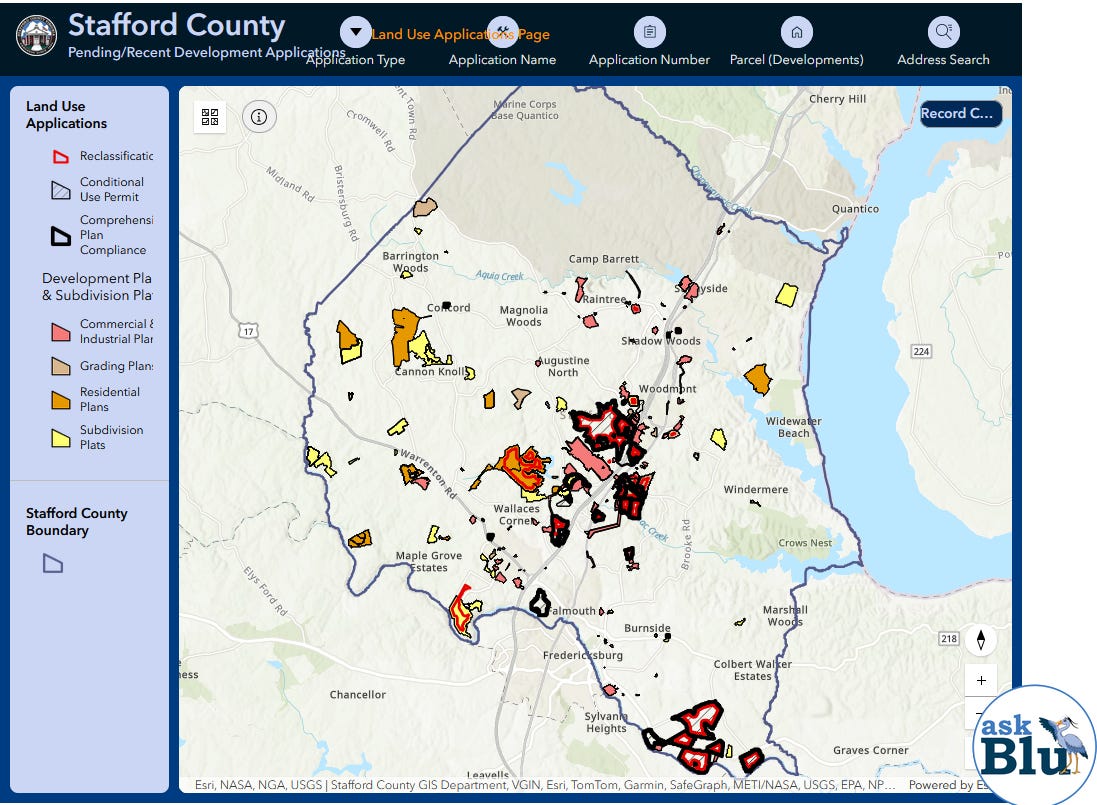
For those unfamiliar with our area, swatches of forest disappear in Stafford County, Virginia every day. I’ve written about this before, including how disorienting the rapid destruction can be to many residents. Bulldozers clear away all vegetation and even the soil underneath, leaving the yellow earth scarred and infertile. Few places seem immune. Just a few years after my wife and I bought our house, the entire forest backing our lot was removed, leaving us atop a windy hill.
Last week, a nearby copse of trees that I’ve admired for decades was unceremoniously scraped away for new homes starting “In the mid-500s.” In the abstract I have long known these trees were vulnerable, surrounded by older houses. But the act itself came as a shock. Especially since this is still early summer and therefore the height of the nesting season. The trees’ sudden erasure sent me back to an ancient puzzle:
What are my kindred members of humanity thinking?
***
A scene from two years ago:
My smartphone vibrates.
A local developer wants to build a village-style retirement community of 141 new homes on Leeland Road. The road runs a mile or so up Potomac Creek from Unicorn Farm, our family home. This proposed subdivision would destroy the 53-acre Clift Farm, currently a graceful expanse of rolling fields touching the old 173-acre farm of Jean Ewalt, a wildlife rehabilitator, and her husband Edgar, both of whom have passed away. These were people I had known.
To build the retirement community, the developer needs Stafford County to re-zone the farmland from A-1 Agricultural to a new designation: R-2 Urban Medium Density Housing. An online petition opposing the change has been created by local residents. Petitioners decry the loss of open space and green vistas that attracted them here, and worry about the traffic that will come. Others speak of the Clift Farm’s notable history; the entire area was a Union Army campsite during the Civil War, and Stoneman’s Switch, a strategic railroad junction, ran just alongside. Abraham Lincoln walked here.
For the most part, the opposition to the retirement community is a classic case of NIMBY politics – Not in My Back Yard. Most petitioners arrived here less than twenty years ago. They occupy newly built, two-story “McMansion” houses, parking their commuter cars along white curbs in the cul-de-sacs where a walnut orchard once stood.
I feel for them, though. Not in my backyard, either. When the petition leader calls me for support, I give him what ammo I have – an online article I wrote on how such housing projects are hurting the water quality of Potomac Creek, which lies within about 1,000 feet of the proposed community – and agree to speak at an upcoming county planning meeting.
A few weeks later, I chat about the coming development with my anthropologist friend Brad, an active citizen of the local Patawomeck tribe. Brad has just finished discussing Indigenous rights with students in my undergraduate seminar. (Afterward, a confused student asks me if Brad is Canadian. His broad waterman’s accent – “about” is “abowt” – is rarely heard these days.)
Brad agrees that the retirement community won’t be stopped. That’s not the Stafford County way. Like me, he worries about the housing development’s impact on the creek, which runs through the heart of his tribe’s ancestral homelands. Increased lawn fertilizers and road run-off will further harm water quality. Brad knows, too, that only minimal cultural resource surveying has been done. He suspects buried sites of historic tribal settlements will be destroyed and associated artifacts lost forever. He informs me of a massive new warehouse, further up Potomac Creek across Route 1, that is also in the planning stages. There, evidence of human settlement has been found (including tell-tale fluted Clovis points) dating back to the earliest Paleoindian era, ten thousand years ago or more. Building the new retirement community may well erase any record of uncounted humans who once lived beside the creek.
Trees and animals will die. Most people won’t notice. But why are we okay with the erasure of our own kind, I wonder? Especially here in the Commonwealth of Virginia, which prides itself as “the birthplace of the nation” and “mother of presidents?” As the country prepares to celebrate its 250th anniversary, Virginia’s clever new marketing campaign can credibly boast: “America. Made in Virginia.”
When considering the wounded land around Potomac Creek, I often struggle to understand the minds of others. It’s a global concern capable of uniting (and occasionally unifying) the social and natural sciences.
Personally, I once tried to glean the thoughts of a visiting migratory bird through science and sheer imagination. I read a number of peer-reviewed studies about the migratory impulse. I cannot say that I succeeded with any confidence. My working assumption was that interiority is, by definition, hidden, but also universal – or something like that.
Then, last summer, standing quiet in the woods, I watched a red-headed woodpecker feed in the bark of a tree several feet over my head. We both paused to exchange glances.
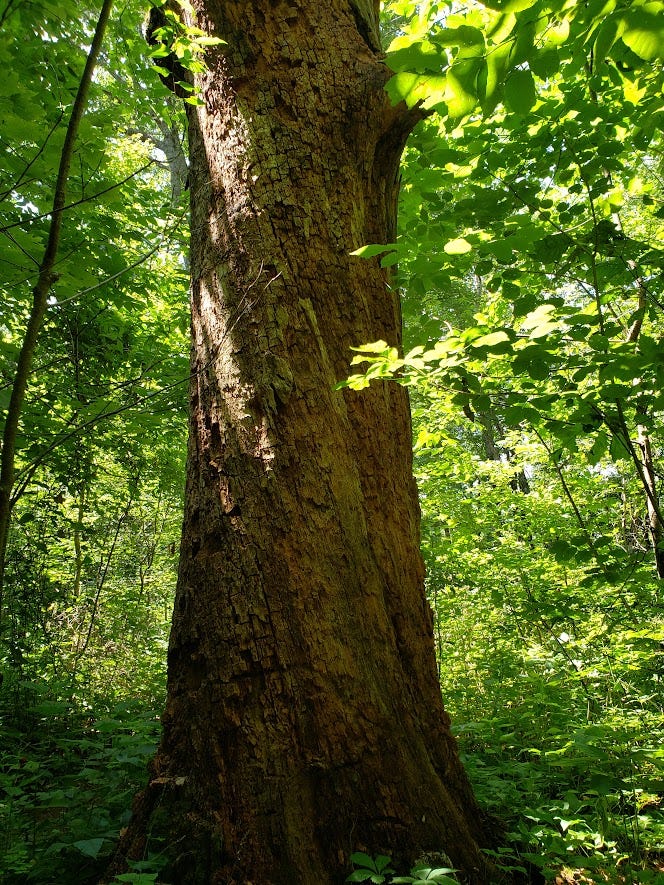
The bird saw me and wondered something, as did I. A moment of mutual regard; I felt illumined, and a little bit startled.
I knew for that instant what it was thinking about: it was thinking about me. A modest but solid insight. Then, as the bird continued its feeding with only a hop or two sideways, I knew, too, that the woodpecker thought rather little of me, despite my species’ awesome supremacy. But I could only make guesses why.
Maybe we shouldn’t mirror-image across species. Assuming a muskrat or owl must think as we do; how immodest is that? Perhaps my whole approach has been wrong. Of course we’re all creatures of nature, fated to act like the animals we are. But differences among species must matter, too, even in an instant of mutual recognition.
Such doubts keep my ongoing book project in flux.
Returning my attention to those of my own species, though, I felt the task of discovery has to be easier.
How do humans understand the land they live on? Well, dead people leave records and material artifacts or write books. Ideas and emotions have archaeologies for us to unpack. An uncovered cache of worn Clovis points clearly says someone viewed this as a good place to find food. A bone flute bespeaks rituals or play. Empathy isn’t such an abstraction here amongst our own; less brute imagination is needed to understand what the dead were thinking. Living humans, too, may tell you directly and in your own language how they feel about a place, as well as about those who came before us.
But, as I had hoped with the birds, you need first to become a stalker of people. Approach quietly. Heighten your senses. Follow them around, perhaps.
The person who pays for the vanquishing bulldozer and the environmentalist who mourns what is to be forever lost; here, too, amongst ourselves, we must seek illuminating moments of mutual regard. Perhaps then we can fathom how the other views the land.
But, for the moment at least, I remain mystified by why we hold such views.
Hi Ranjit,
I recently wrote a paper arguing that forests close to urban and residential areas have enormous disease-preventive value. The costs of lifestyle-related diseases are growing exponentially, and nearby forests—when combined with well-guided forest bathing—can play an incredibly important role in prevention, recovery, and recreation. In fact, their societal value can be as much as 120–180 times greater than the value of the timber itself.
Could this line of reasoning be useful here?
After all, people often buy homes in these areas precisely because of the forest. It is a major part of the property's value. If someone moves to a neighborhood because it is surrounded by woodland, and that forest is later cut down, the value of their home could drop significantly. One could argue that, in such cases, the developer should even be liable for compensation.
What do you think?
Ranjit describes this well. This is happening all over the county at a breakneck pace. This forest loss, along with our historical and cultural resources being equally bulldozed, is literalky and figuratively erasing who and what we are as a society.