

Cross hatching
When the land becomes disorienting

This post explores a question that often arises from the study of Potomac Creek:
How do people lose their sense of place?
Land inhabited by people ages like skin. New lines form, cross-hatching the old. Time alone is a sufficient condition.
For most of the 18th century, the area of Potomac Creek, including Marlborough Point, was the heart of activity in Stafford County. Attempts by colonial authorities and investors to create a lasting township failed to take root, however. The area lost its economic importance.(1) Decades later, the 1860 census – on the eve of the Civil War – recorded a County population of only 8,633. About thirty-nine per cent of Staffordians then were Black, the great majority of whom were enslaved.
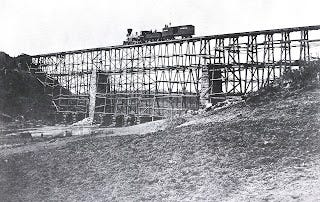
Wartime occupations by the 135,000 soldiers of the Union Army of the Potomac as well as far smaller Confederate forces left behind an utterly deforested landscape. Black and white photographs from that period typically show a treeless and inhospitable county. One can only imagine the effects upon local wildlife, like migratory fish and birds.
Humans responded to the war and ecological disaster in predictable ways — they started moving. Encouraged by the federal presence, 12,000 enslaved Blacks escaped north through Stafford County. Many crossed Potomac Creek to do so.
After the war, White families hit the road, too. Northern-led Reconstruction offered them little room for optimism. Their formerly enslaved laborers gone and exposed topsoil washing away, many county residents moved to Kentucky where Southern sentiment remained strong.
Local historian Eby describes a post-war County with a small, dispirited population and an economy that would not recover until the 1970s.(2)
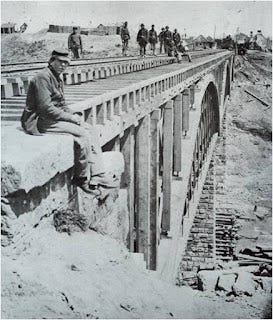
Today, it’s possible that a few of Stafford’s very oldest residents may also recall being relocated by another war. Marine Corps Base Quantico displaced locals in 1942 to occupy 30,000 acres – almost a quarter of the County. Three hundred fifty families had to leave on short notice, twenty to sixty days, their land condemned by the federal government.
But what’s happened since was probably unthinkable to most residents in 1942.
Stafford County is now in one of the fastest growing areas in the country. Its current population of 170,000 is four times what it was in 1980 (it was less than 25,000 when our family moved here fifty-odd years ago). As the federal government continued to swell, the I-95 interstate highway bisected the County in the 1950s. The interstate parallels old and tedious Route 1, a dirt road paved earlier in the century. A popular, new commuter rail line tied Stafford to Washington DC in the 1990s.
These novel pathways reset the flow of people and goods along a north-south axis, away from the natural, mostly east-west passages long mandated by local rivers and creeks. New families in need of homes rushed in.
Today, the part of I-95 running through Stafford is absurdly congested, often called the worst traffic “hotspot” in the nation.
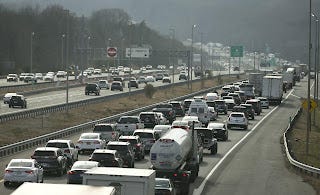
The upshot: This is a disorienting place to live. Big changes have influenced and even disrupted residents’ sense of place. As happened after the Civil War, and after Captain John Smith’s visit to local Indians from Jamestown in 1608, and doubtless many times before Europeans ever walked here, Stafford County is once more a place of been heres and come heres. There isn’t a settled, communal idea of place anymore.
And it’s hitting many residents hard. Not long ago, an elderly woman told me that she knows people who are waiting for her to die so her property can come to market. Then, her rolling land would be developed and occupied by strangers.
How many historical creek residents have known similar fears? Have experienced this loss of control, and felt foreboding towards incoming peoples? Have felt their land turning against them, no longer their home?
The land itself is a palimpsest of peoples.
Does this describe where you live?
1. Jerrilyn Eby, They Called Stafford Home: The Development f Stafford County, Virginia, from 1600 until 1865. (Heritage Books: 1997): 174-187.
2. Ibid., 289-291.