

A contingent existence
Mumbling again

N.B. This piece falls into the category I call “Mumblings.” I use this label for essays where I think I’m onto something and feel compelled to write about it now, but haven’t pulled it all together yet. So, I put it here, on No Lines in Nature, essentially to see what comes out.
***
I penned an article a while ago on the fascinating human history behind a prolific invasive species, Japanese stiltgrass. Stiltgrass is everywhere here in Virginia. In fact, its continued progress across the landscape is inevitable. So much so that one is compelled to question the whole point of the struggle to contain it.
Despite this inevitability, the methods used to halt its spread often involve the use of toxic chemicals and mechanical violence. Stiltgrass, like spotted lantern flies, Burmese pythons, and many other non-native species, is caught up in the endless and deeply controversial “War on Invasives.”
My point here: “War” is such a revealing metaphor, isn’t it? We see ourselves in violent conflict with so much of the life surrounding us.
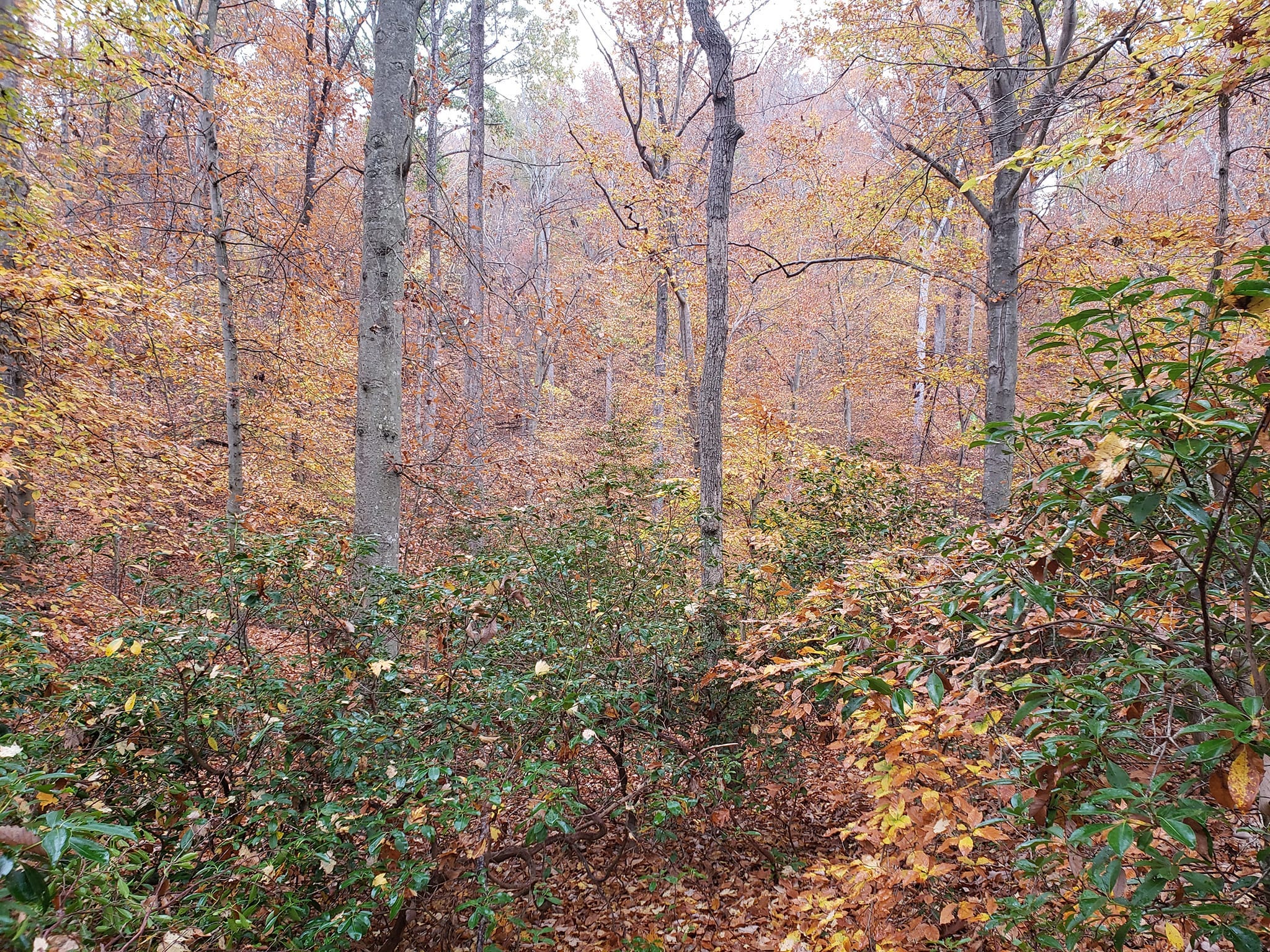
And it’s simply too much to ask someone with my personal and professional background — an immigrant professor of politics who formerly taught for a national war college — not to look for the moral dimensions of the use of violence. Even violence directed towards a plant.
Perhaps, especially, a plant.
I cannot judge the ecological or scientific merits of the competing sides in the debate over invasive species. However, in my view, moral questions arise at every stage of the decision to pull a live plant from the ground it needs to survive. Such questions include: Who decides which species shall live or die? Upon which and whose criteria? By whose hand? And by what means?
I would also argue that doing the right thing matters greatly in the war on invasive species. Defining success, in particular, is a moral imperative. After all, this is a debate about life and death, and on a massive scale. I doubt I’m the only person who feels a pang when tearing a live plant from the ground.
And all this means such matters shouldn’t be left wholly to the scientists.
***
Allow me a momentary diversion. I promise it connects to the above argument.
I want to tell you about my cherished Indian cousin.
Now a leading expert in robotics and machine learning, he came to the United States for undergraduate studies in the 1980s. Lacking funds, he took on multiple unskilled jobs. The most memorable ones – in the olfactory sense – were in the sweltering kitchens of local seafood restaurants and crab shacks.
To minimize the impact of this dirty work, he wore the cheapest possible shoes, the type with velcro ties that cost eight dollars. For years, he smelled of pungent crab spice.
Until he could drive, my cousin bicycled to work, forced to use multilane highways built only for gas-powered cars and trucks. His skinny silhouette embodied the striving immigrant: dark, with a thick mustache, pedaling the gravelly shoulder of the road to get somewhere he needed to be.
This was too tempting a target. A large truck swerved right to knock him into the ditch. His bicycle wobbled and crashed. Lying shaken in the dirt and fast-food wrappers, my cousin looked upward to see who had forced him off the road. The truck driver stopped to stare down at him and laugh, before driving on.
Undaunted, my cousin found refuge on our family farm on Potomac Creek. And there, his American roots finally took hold.
Yet another metaphor: “roots” — what one needs to thrive in place. So often we speak of people in such terms. Botany gives us powerful frames for understanding all life.
“Plant” itself is both a noun, denoting vegetative life, and a verb, describing the fixing of life into the soil to grow, from the Latin plantare: “to drive in with the feet.” The verb itself celebrates the use of power; the Roman legionnaire’s boot willfully introducing something where it was absent before. Likewise, to pull a plant from the ground is also an act of force – to “uproot” what already grows.
All life struggles within this pendular world, swinging between just and unjust uses of violence. How concisely these two words, “plant” and “root,” capture the struggle over a given place waged between willpower and brute force.
In this way, the story of Japanese stiltgrass and the immigrant’s tale offer a connectivity I have been seeking: the knitting together of old knowledges to make a new whole. Environmental scholar Christopher Stone understood this necessity when he wrote we need a new myth “that can fit our growing body of knowledge of geophysics, biology and the cosmos.”1 Biology, history, ethics, law, politics — I am prompted to look for more and broader connections.
The truth may well be that the human migrant looks at the war on invasive species through a different lens than the native-born. This is because the act of unleashing, as well as of containing, new species is always an exercise in politics, culture, power, and moral reasoning. And because the migrant always lives a contingent existence.
The debate over invasive species is only partly a question of science. It is also a question of how we move through the world.
I’ll leave it there for now.
Christopher Stone, “Should Trees Have Standing? Toward Legal Rights for Natural Objects.” Southern California Law Review (1972): 450-501.
Really enjoyed reading this! I've often been a little dismayed by comments in native plant discussion groups that tell people asking about non-native plants to "kill it" or "rip it out" or use herbicides to kill these plants. I am a fan of native plants and we do grow large patches of mountain mint, milkweed, and even Virginia creeper - but we also grow, and enjoy, many non-native plants.
My background is geology, and we tend to think about environments and ecosystems over the course of tens or hundreds of million of years. And things do change considerably - and they are continuing to change. So labeling something non-native because it wasn't here a few hundred years ago and going to war with it....not sure about that.